
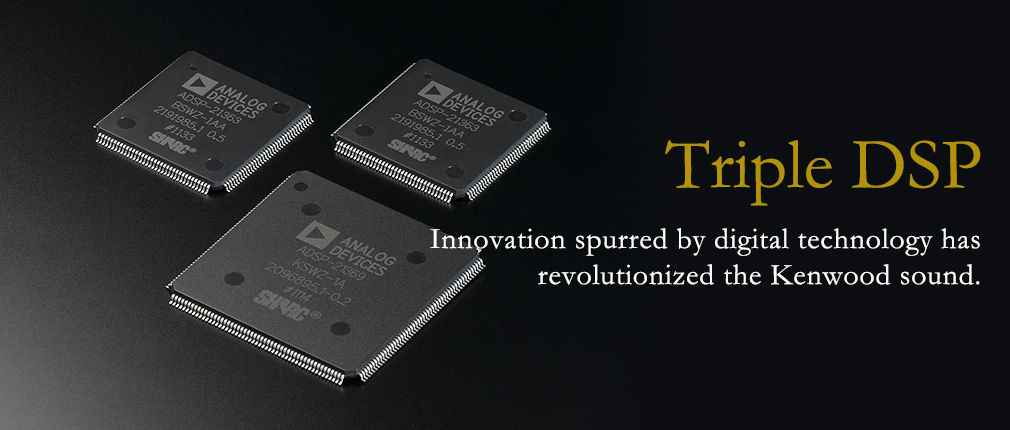
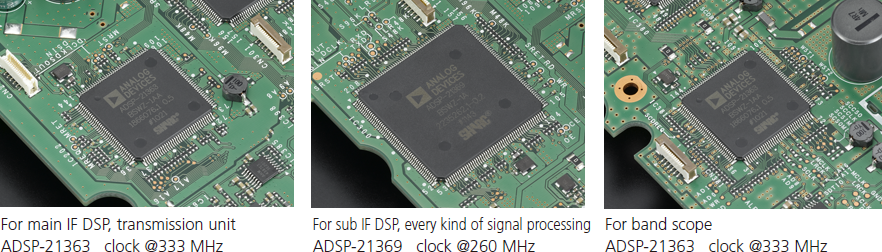
Equipped with dedicated DSP for the main receiver, sub-receiver,and band scope
KENWOOD continues to provide quality sound transmission that is unattainable through analog circuits.
By installing the world-premiere DSP in the TS-950 and achieving IF AGC control on the TS-870,
our experience has led to the use of three DSP units, one on each major block of the TS-990S.
By distributing the signal processing of the main IF, band scope, and sub-IF, we have realized ample digital signal processing power.
(FM mode is AF DSP processing.)
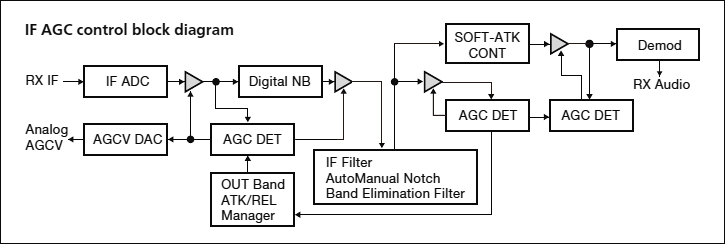
Advanced AGC control, fusing together digital and analog
The reception sound quality of SSB and CW is not solely determined by audio frequency and filter delay properties. AGC characteristics play a very significant role as well. The opinion of many of our fans that “even for long periods of time they never get tired of listening” is due to the characteristics of KENWOOD’s AGC. The TS-990S goes a long way in helping further refine the KENWOOD sound by innovating not only the AGC control algorithm on the DSP but also the analog AGC unit as well.
Extensive interference elimination and noise reduction functions
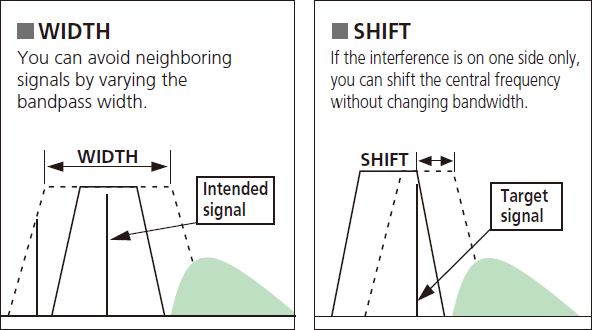
IF filter bandwidth variability
You can vary DSP filter bandwidth and eliminate extensive interference depending on use and condition. You can operate it as a HI CUT/LOW CUT function in SSB/AM/FM mode, and WIDTH/SHIFT function in CW/FSK/SSB-DATA transmission mode.
The noise blanker function (NB1/NB2) is equipped with digital/analog 2 format
Equipped with an analog noise blanker (NB1) which is considered effective against weak noise, and a digital noise blanker (NB2). Choose the NB1 or NB2 based on noise type and reception condition. With NB1, stable noise reduction is possible without depending on reception bandwidth. NB2 is effective against noise that cannot be tracked by an analog noise blanker. Plus, both the NB1 and NB2 can be used simultaneously with the TS-990S.
DSP-based noise reduction function (NR1/NR2)
The device is also equipped with two types of noise reduction format-NR1 and NR2. An optimal noise reduction format is applied to each reception mode for NR1. And for NR2, SPAC method is applied which is more effective in CW operation.
<Other extensive interference elimination and noise reduction functions>
•Beat cancel function (BC1/BC2)
The beat cancel function is effective against relatively weak, multiple beats,
whereas the IF auto notch is effective against strong beats.
•Audio peak filter
You can vary bandpass width of pitch tone when there are carrier receptions
like CW and FSK. FSK is compatible with mark and space frequencies.